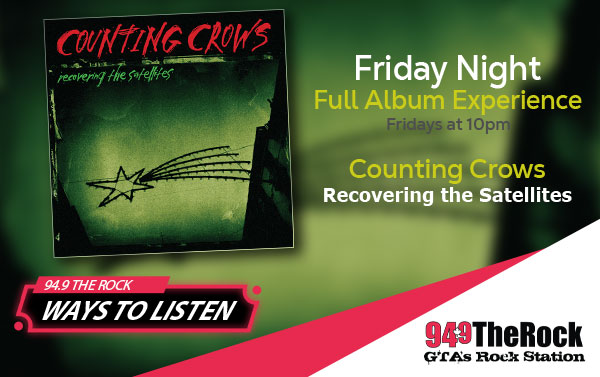

October 16, 2026
Released in October 1996, Recovering the Satellites was Counting Crows' highly anticipated follow-up to their hugely successful debut, August and Everything After. After the success of songs like “Mr. Jones” and “Round Here,” the band had suddenly gone from struggling musicians to international stars. Rather than simply attempting to recreate the sound of their debut, singer Adam Duritz and the band used their second album to explore what happens when you finally get everything you thought you wanted—and discover that it doesn't necessarily make life easier.
Musically, Recovering the Satellites was a significant step forward for the band. While August and Everything After leaned heavily toward acoustic, rootsy and intimate songwriting, the new album was bigger, louder and more restless. The addition of guitarist Dan Vickrey and drummer Ben Mize gave Counting Crows a much broader musical palette, while producer Gil Norton helped shape the album's more powerful sound. Tracks such as “Angels of the Silences” and “Have You Seen Me Lately?” demonstrated a new urgency, while quieter songs such as “Goodnight Elisabeth” and “Monkey” preserved the emotional vulnerability that had become a trademark of the band.
Lyrically, the album is filled with themes of change, isolation, relationships, nostalgia and the uneasy transition into adulthood. Songs like “Have You Seen Me Lately?” explore the feeling of becoming a different person while the world still remembers who you used to be. The title itself is an intriguing metaphor: satellites are objects in orbit, disconnected from the world below. “Recovering the Satellites” suggests trying to bring those scattered pieces back home—to reconnect with yourself after being thrown into a completely different life.
Throughout the record, Duritz's songwriting creates a cast of characters and situations that feel both intensely personal and universal. “Daylight Fading” captures the feeling of watching time disappear faster than expected, while “Another Horsedreamer's Blues” and “Children in Bloom” look at dreams, memories and people trying to escape circumstances that have become difficult to change. “Miller's Angels” adds another cinematic moment to the album, while “I'm Not Sleeping” captures the restless feeling of being unable to escape your own thoughts.
Then comes “A Long December,” arguably the album's defining song. Reflective and melancholy, it looks back at disappointment, loss and uncertainty while still leaving room for the possibility that the future might be better. That balance is perhaps the reason the song has endured for so long. It doesn't promise that everything will be fine—it simply suggests that, after a difficult year, there is still a chance that something good might be waiting around the corner. The song became a major hit, reaching No. 1 in Canada and the Top 10 in the United States.
Ultimately, Recovering the Satellites is much more than a successful second album. It is a snapshot of a band trying to find its identity after being suddenly thrust into the spotlight. Where August and Everything After was about wanting something more, Recovering the Satellites is about discovering what happens after you get it. It's louder, darker and more expansive, but underneath the guitars and big melodies is the same vulnerability that made Counting Crows special in the first place—a search for connection, meaning and, ultimately, a way back home.